
Full Grain vs Top Grain vs Genuine Leather: What’s the Difference?
When shopping for leather goods, you will often encounter the terms full grain leather, top grain leather, and genuine leather. While they may sound similar, these labels represent very different levels of quality, durability, and craftsmanship. Understanding the differences can help you choose leather products that offer long-term performance rather than short-term appearance.

Leather comes from animal hide, which naturally consists of multiple layers. The outermost layer of the hide is the strongest and most durable, containing the natural grain that gives leather its structure. As manufacturers split the hide into layers, the characteristics of the leather change, which is why different grades exist.
What is the difference, Full Grain vs Top Grain vs Genuine Leather?
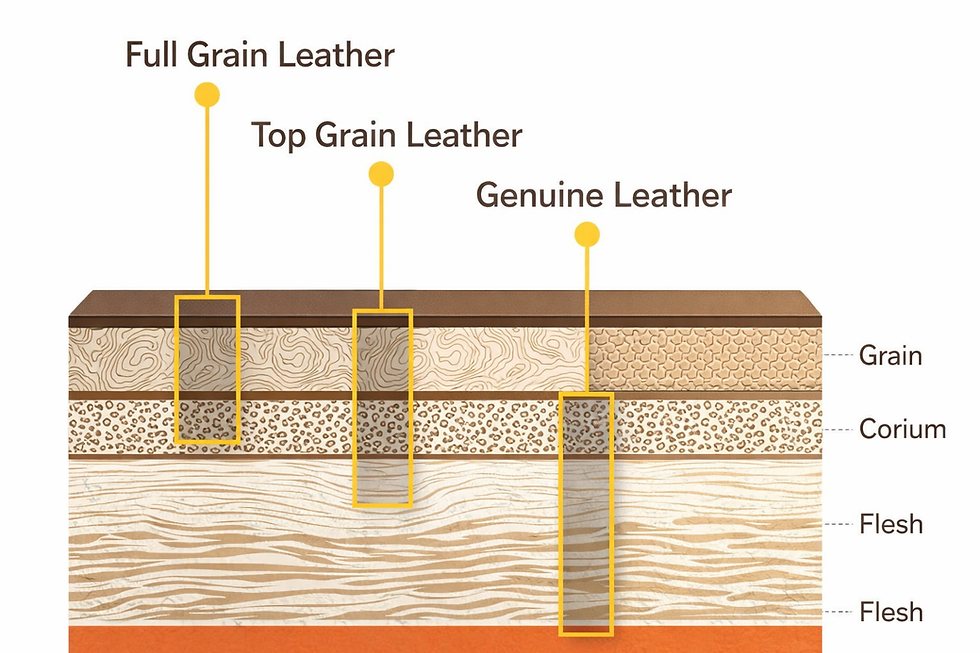
Full grain leather is widely regarded as the highest quality leather available. It uses the entire top layer of the hide without sanding or altering the natural grain. Because the fiber structure remains intact, full grain leather is exceptionally strong, durable, and capable of withstanding decades of use. It also maintains the natural character of the hide, meaning subtle variations and markings may be visible. These features are not flaws but signs of authenticity and quality.
Top grain leather is also sourced from the top layer of the hide but undergoes light sanding or buffing to remove natural imperfections. A finishing layer is often applied to create a smoother and more uniform appearance. This process results in leather that is still high quality and durable, but slightly thinner and less robust than full grain leather. Many premium leather goods use top grain leather because it balances durability with a refined aesthetic.
The term genuine leather, despite sounding premium, simply means that the product contains real leather. It typically comes from the lower layers of the hide after the top layers have been removed. Because these layers are weaker and more fibrous, they often require heavy processing, coatings, or artificial grain embossing to achieve a finished look. As a result, genuine leather products tend to have lower durability and may wear out more quickly than higher-grade leathers.
A useful way to think about these categories is to compare them to wood. Full grain leather is similar to solid hardwood, top grain leather resembles refined hardwood with a finished surface, and genuine leather is closer to engineered wood products. They may appear similar initially, but their longevity and structural integrity differ significantly.
For anyone investing in leather goods, understanding these distinctions is essential. Higher quality leather retains the strength of the hide and maintains its structure through years of everyday use, while lower grades rely more heavily on processing and coatings.
At Laeuer Studio, the focus goes beyond simply choosing leather. The construction, thickness, structure, and finishing all play critical roles in how a product performs over time. Well-crafted leather goods should feel substantial, age gracefully through use, and remain dependable companions in daily life.
By understanding what the differences between full grain, top grain, and genuine leather, consumers can make more informed choices and appreciate the craftsmanship behind truly high-quality leather products.


Comments